New year, new blog post! I’ve been away from my blog for a while, but I’m ready to start writing again!
Before taking a hiatus from blog writing, I had mapped out a 5 part blog series on my Master of Environmental Science journey. This is part one of that series and focuses on my application and acceptance into the master’s program.
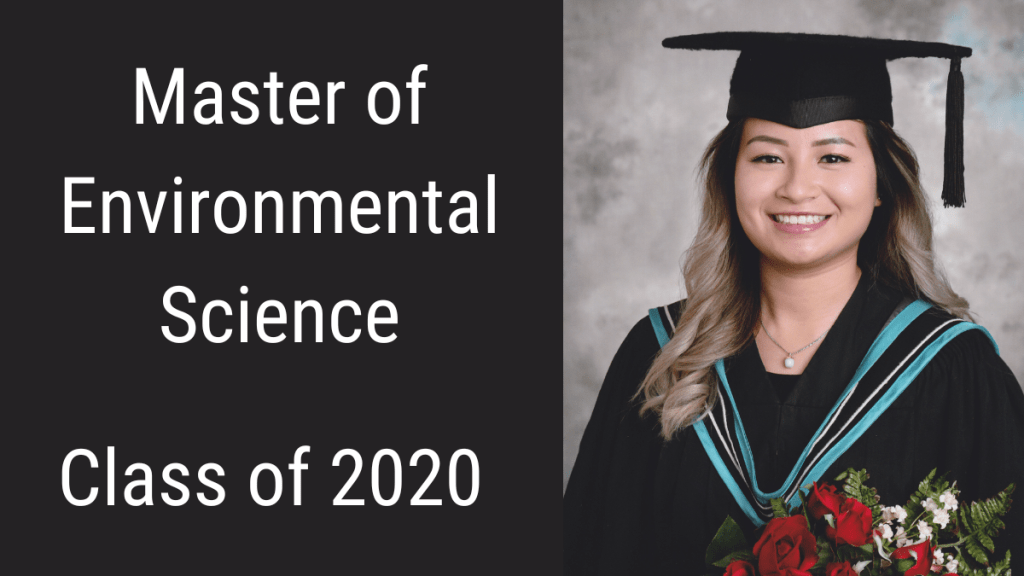
At the end of 2020, I graduated with my Master of Environmental Science (MEnvSc) degree specializing in conservation and biodiversity from the University of Toronto. Although my convocation looked significantly different than what I imagined, it was still a day to celebrate! You may or may not know that I applied to my master’s program about one month before starting.
In late 2018, I was in the final semester of my undergraduate degrees, and a friend introduced me to the University of Toronto’s Master of Environmental Science Program. It is a one-year professional master’s program focused on developing relevant skills for working in environmental science. I knew that I wanted to pursue a master’s degree eventually down the road but at that instance.
In early 2019, I spent seven months interning as a field assistant studying southern pig-tailed macaques in Malaysia. I had a great time and gained valuable experience conducting observational behaviour research on wild primates. I am incredibly grateful for that experience, but I knew that fieldwork was not what I desired for a long-term career. As my internship was ending, I started applying to full-time jobs. After viewing hundreds of job postings and submitting dozens of job applications, I had no luck. I began to reflect on why I was having difficulty receiving any job offers:
- I did not have a master’s degree. I know that having a master’s degree does not guarantee a job, but almost all of the jobs I desired listed having a master’s degree as a minimum requirement.
- I did not have the necessary skills listed as requirements for specific jobs. Some of these skills include knowledge of environmental policies and experience using ArcGIS.
In August 2019, after months of applying to jobs and not hearing anything back, the idea of doing a master’s degree started to come to the front of my mind. On a whim, I decided to look up the Master of Environmental Science Program at the University of Toronto again. I emailed to ask for more details, thinking that I might pursue a master’s degree the following year in 2020. As luck/destiny (whatever you would like to call it!) would have it, a response from the program asked me to submit an unofficial transcript and resume as there was a possibility they would be able to accept me into the 2019 cohort. After submitting those documents, I received a response asking me to submit a formal application, including a letter of intent, official transcripts, and three reference letters. Over the following days, I worked to submit my formal application and ask my previous supervisors for a reference letter. I have to admit that it was a stressful few days.
A week after submitting my formal application, I received my acceptance letter! I was still in Asia at this time, so there were a few things I needed to do:
- Call my parents to let them know that I was returning to Canada to pursue a master’s degree.
- Book my plane ticket home to Calgary and then book a plane ticket to Toronto.
- Register for my graduate classes (the class registration date was one day after receiving my official acceptance letter).
- Find a place to rent in Toronto.
- Let reality catch up to me that I would start my master’s degree less than a month from when I applied.
- Move to Toronto and start my master’s degree!
If you read one of my previous blog posts, you might know that I believe “opportunities are for those that are prepared.” While it looks pretty last minute that I decided to pursue my master’s degree (and I can admit that it was last minute!), I was accepted into the 2019 cohort because of years of preparation. The preparation steps I took may not be as apparent as someone who has a direct plan for their career pathway, but it does not mean that I was not prepared. During my undergrad, I sought new opportunities to conduct research (leading me to complete two undergraduate theses and five research-focused field schools). I also sought opportunities to give back to my local community through volunteering at local non-profit organizations and animal rescues. And although this last task might be small, it was also part of my preparation: sending that initial email to ask for more details about the master’s program.
If there are two things I want you to take away from today’s blog post:
- Always seek new opportunities, even if they might not align with your idea of how your career path should look. These opportunities could lead to something beyond your wildest thoughts!
- Send that initial message, email, or job application, because it could be life-changing.
Before I finish off this blog, I want to give a shoutout to the 2019-2020 cohort 2019-2020 cohort of the Master of Environmental Science Program at the University of Toronto, whom I’m forever grateful to have learned and laughed alongside.
Cheers,
Christine
 Christine Song