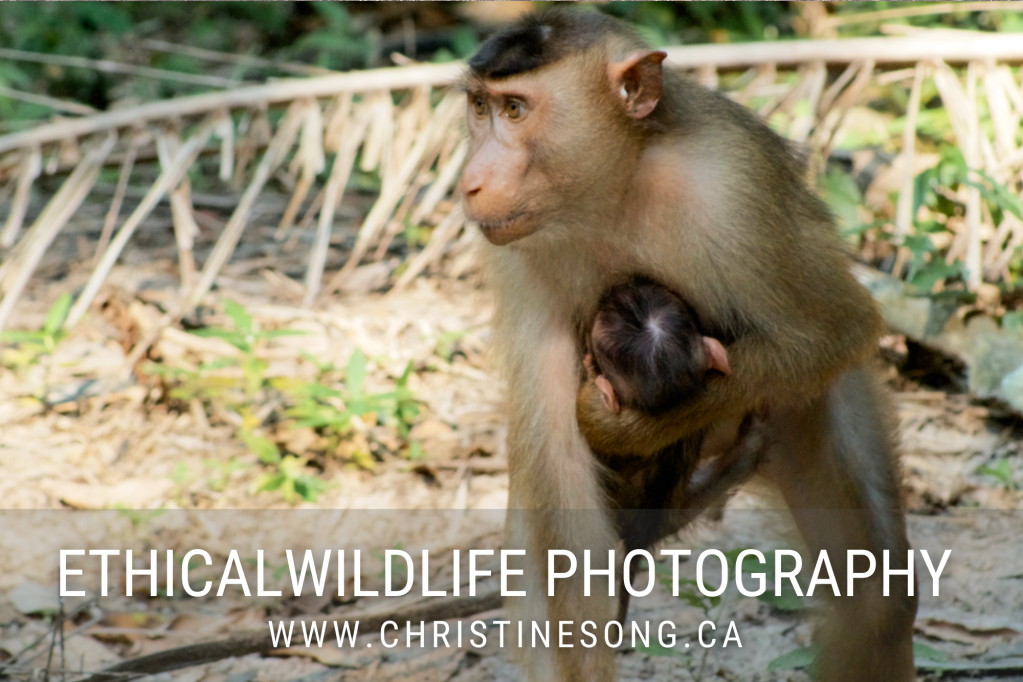
I recently wrote a short post on my Instagram (@christinesong.ca) about ethical wildlife photography inspired by the above picture. I thought that it would be a good idea to write this blog post so I can discuss more about the importance of ethical wildlife photography.
When I was interning as a monkey field researcher for the Macaca Nemestrina Project in Malaysia, I had the opportunity to photograph many different kinds of wildlife! As the name of the project implies, we studied southern pig-tailed macaques (Macaca nemestrina). During my 7 months interning, I definitely amassed thousands of pictures of our study monkeys, as well as other wildlife.
When infant monkeys are born, their mothers become really protective. It’s not uncommon for the mother and their infant to seemingly disappear for a few weeks because the mother becomes so discrete and hides her baby and herself from observers. After a few weeks of only seeing Jane and her newly born infant Jazz high in the tree canopy, I spotted the duo on the ground! This was definitely a lucky day and I took the opportunity to snap a few pictures of them while making sure I was a good distance away since they are wild animals.
Jane eventually spotted me watching her and Jazz. She promptly then grabbed Jazz and moved to a different location where I could no longer see them. This brings up the discussion of ethical wildlife photography and research on wild animals. Do no harm is one of the top priorities for wildlife photography highlighted by National Geographic photography Joel Sartore. This includes: not changing the environment, not interacting with or disrupting animals, and watching signs of stress in the subjects.
In this instance with Jane, her behaviour of grabbing Jazz and moving away let me know that she was not comfortable with me watching them and it is important for me to respect that. There will always be endless opportunities for taking good wildlife pictures, so respecting subjects should always be a priority. I spent the next few hours watching other primates and it caught me by surprise when Jane and Jazz ended up wandering close to me later that day.
Keeping an appropriate distance from wildlife also helps protect us as well. I’m sure that you have seen videos online of people leaving their cars to photograph wild bears and the bear suddenly starts charging towards the people. Events like these stress animals out, put the animal at risk of having to be euthanized, and are avoidable if proper precautions are taken. I know that the opportunity to observe and photograph wildlife is definitely exciting, because I always get incredibly excited when I get the opportunity to see wildlife as well. Just remember to do no harm!
Cheers,
Christine
 Christine Song