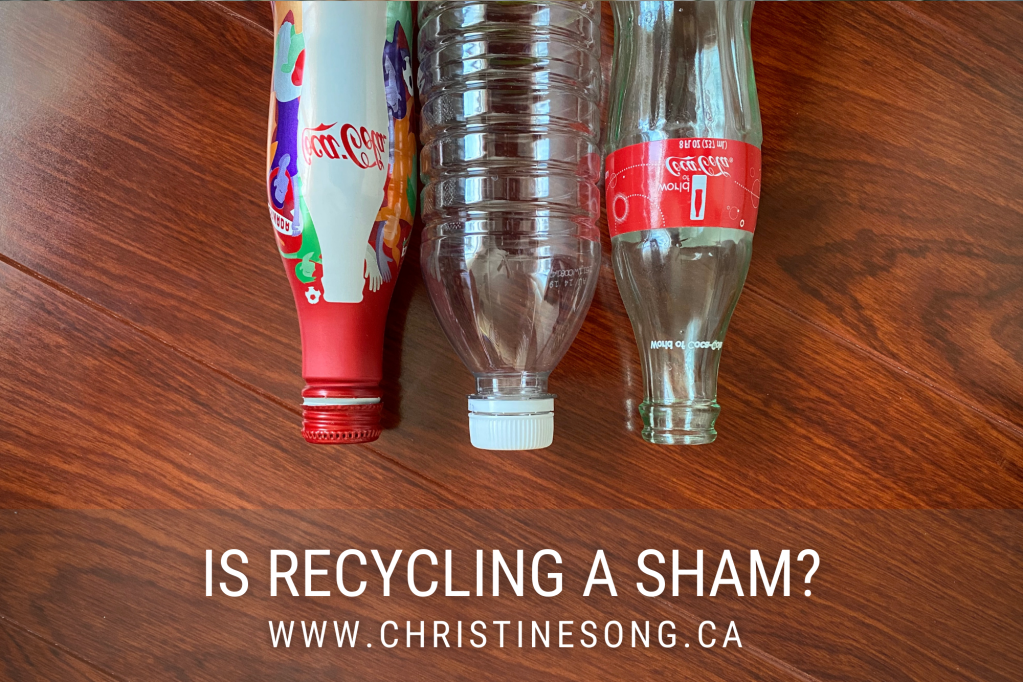
Many recently published articles and a conversation with a close friend inspired today’s blog post. In the news, I have noticed a few articles that claim recycling is not as effective as we have been led to believe. My close friend shared one of these articles with me, which sparked a conversation about the effectiveness of recycling. During our discussion, a few topics arose that I’ll be talking about today. I’ve included some questions in today’s blog post to urge you to think about how your recycle items and the recycling processes as a whole.
Plastic cannot be recycled forever.
A piece of plastic can only be recycled a certain number of times before it becomes A piece of plastic can only be recycled a certain number of times before it becomes too degraded to recycle. Glass and aluminum, on the other hand, can be recycled indefinitely without becoming degraded. As such, buying a pop (or a soda, depending on where you live!) in a glass bottle or aluminum can is better than a plastic bottle for recycling purposes. If you want to read more information about the number of times that materials can be recycled, check out this article here!
Don’t crush your aluminum cans.
Depending on your city’s recycling program, crushed cans may not actually be recycled or may be more difficult to recycle than uncrushed cans. At first thought, Depending on your city’s recycling program, crushed cans may not be recycled or may be more difficult to recycle than uncrushed cans. At first thought, this might not make any sense because when I think about recycling cans, I know that cans will be eventually crushed by machines anyways. So the act of consumer crushing cans should not affect the recycling process, besides saving space, right? It turns out that crushed cans may be more challenging to recycle because they are smaller and might fall into gaps during the recycling process. It’s best to check with your city on whether they prefer crushed cans or not. The guidelines for the recycling depot where I live indicate that crushing milk jugs is fine, but smaller bottles and cans should remain uncrushed when bringing them in for recycling.
Different cities have different recycling systems.
JJust like each city’s ability to handle crushed or non-crushed items, items that can be recycled in certain cities may not be recycled in other cities. One item, for example, is black-coloured plastics. You know how when you buy takeaway sushi, the top of the container is clear plastic, and the bottom is black-coloured plastic? The bottom of the container is not accepted for recycling in Toronto but can be recycled in Calgary. The reasoning for this is that coloured plastics are harder to recycle – But then that brings up the question, why do we have coloured plastics anyways? Why not just make sushi containers that have both a clear top and bottom?
Mixed material items are likely not recycled.
Think about those pasta containers with a small plastic window or envelopes with a plastic window. If you don’t remove the plastic window from these items, they will likely not be recycled and be tossed during the recycling process. Again, this brings up another question. Why is there a need to have a plastic window?
Recycling needs to be clean.
Recycling that has been contaminated with food will not be recycled. In my househRecycling contaminated with food will not be recycled. In my household, we always rinse our plastics before putting them into recycling. I realize that this might not be possible for all households. I also recognize that other households might not know this necessary step. What happens if contaminated plastics come into contact with clean plastics? Does the whole batch of recycling then become trashed?
It takes a certain amount of privilege to avoid plastic.
It is easier said than done to say, “the simple solution is just to avoid plastic.” It is not a simple solution at all. For instance, when thinking about food, bulk shops are available to bring your containers to fill up on goodies. However, this is not possible during the current COVID-19 pandemic. It also may not be reasonable for all people to visit a bulk shop. Before a closer bulk shop opened near me, the closest one would have been across the city. Additionally, buying food from bulk shops is not always cheaper than buying pre-packaged foods from a grocery store.
Refuse, reduce, reuse, recycle, rot.
This is a commonly suggested order of how we should consume material items:
- We should be refusing items that we do not need. These can be simple items, such as denying a receipt or single-use plastics.
- We should reduce our consumption of items and be more intentional about things that we choose to purchase, such as making sure that we will use that item.
- We should try and reuse items to the best ability. I like to reuse old clothes as rags for cleaning.
- We should recycle any items that we no longer require.
- We should let items rot (that can!) in a compost system.
We can do our part – but we also need to hold large corporations responsible.
As consumers, we must do our part to recycle when we can. It is also essential to recognize that most plastic waste comes from large corporations. Companies need to be more responsible about reducing the waste they produce and more intentional about how they dispose of trash.
I hope that today’s blog post made you think about current recycling practices globally. If you want to chat about recycling, plastic waste, or any other environmental-related topics, please feel free to leave a comment or send me an email!
Cheers,
Christine
 Christine Song
3 responses to “Is Recycling a Sham?”
I think recycling is overrated, and putting recycling in blue bins can often give us a false sense of security, making us feel like our consumption had little to no impact on the environment. I feel that ‘reduce’ and ‘reuse’ are FAR BETTER than ‘recycle’, though they are often compromised by convenience – and perhaps our laziness.
LikeLike
Thank you for taking the time to read my blog post, Sandip! I agree that it is better to reduce our consumption and reuse items before considering recycling. Recycling should be used as a last resort for items that we no longer need, especially since most items placed in our blue bins likely are not recycled anyways based on recent news that has come to light.
LikeLike
[…] glitter decorations. Additionally, recycling is not the most sustainable practice (read more on my blog post here to learn more about recycling!). Alternative forms of wrapping, such as using fabric or paper bags […]
LikeLike